"Gardening is about enjoying the smell of things growing in the soil, getting dirty without feeling guilty, and generally taking the time to soak up a little peace and serenity. " ~Lindley Karstens
Showing posts with label China. Show all posts

Wednesday, April 27, 2011

A Touch of China for My Indoor Garden

Before my husband went back to China to visit his parents recently, he asked me what I wanted him to bring from China.  Well, can you guess what I asked for?  No, not plants, not seeds, since it is illegal to bring those back to United States from foreign countries.  What else could be close to what a gardener wants?  Yes, some containers!

No, I was not asking him to carry those big heavy pots all the way across Pacific. I wanted something beautiful, reasonable sized, and of course in Chinese Style.

He brought me back five beautiful pots for indoor plants.  They are all hand made by pottery craftsmen.  Each one has those traditional Chinese pottery design elements, such as poems, or poetic Chinese phrases inscription, mountain/water drawing, bamboo, orchid, lotus flower, or Plum flower drawings.  To show you the detail of those elements, I made one collage for each pot. You also can click each picture to enlarge it.

My original intent was explaining to you what are those Chinese words mean by translation, but only found they just lost its poetic rhythm after translation.  So I only can point you out that those words have something to do with "Breeze", "Moon", "Fragrance", "Charm", and etc.  Now, use your imagination to make up some poetic words in your mind when you look the pictures :)

The plant in the first pot is Fern "Green Fantasy" (Nephrolepis exaltata), a gift from my friend.  I have been looking for this fern for quite a while because it is a very popular indoor plant in China.  Now it just looks perfect in this Chinese style pot, bringing me so many nostalgic feelings...

Update:  FlowerLady found the picture of Fern "Green Fantasy" does not match the plant.  I looked it up over the Internet, and I think the correct name for this fern is: Asparagus setaceus. The original tag that came with the plant was obviously mislabeled.   Thanks, FlowerLady!


The plant in the second pot is my newest purchase, Paphiopedilum orchid, or Lady's Slipper Orchid (yes, my orchid collection is growing!).

The following two pots had Phalaenopsis orchids.


This one not only has drainage holes at the bottom, but also on the sides.   Would be perfect for orchids growing.


This one has most unique shape, curved triangle.  I have not found a suitable plant to put in yet.  It looks beautiful enough even just by its own.


All pots except the third one (the lighter color) are all made of famous ZiSha (purple) clay, although the color is not really purple.   You probably also see the Chinese Tea pots made of the same material.

I am so thankful that DH brought all these beautiful pots for me.  You can imagine how hard to carry on and protect these fragile pots on a total 24 hour long journey.

Now finally I am having a touch of China for my indoor garden.

Wednesday, September 22, 2010

Happy Mid-Autumn Festival

On the 15th day of 8th month in lunar calendar, Chinese and lots of people in Asia countries celebrate the Mid-Autumn Festival, which sometimes is also called "Moon Festival", since the moon is supposed to be the roundest and brightest of the year on this day. This year, the mid-autumn festivall falls to today, September 22nd, 2010.

As much as I like to give you a perfect explaination of the origin of Mid-Autumn Festival, I found myself is short of words, as well as time today. So, if you are interested in learning more about this traditional Chinese festival, you can read it here.  Also, Autumn Belle at "My Nice Garden" wrote a sieries of posts about "Mid-Autumn Festival", and I am sure you will enjoy her beautiful writings very well.

The full moon is also a symbol of reunion for Chinese.  So usually family would get together on this day to enjoy a nice dinner, and then go outside to look up the moon, eat the moon cakes and spread the good wishes to the loved ones.  We did eat moon cakes today, and I also took a picture of this full moon. 


When I looked up the moon, I was thinking about my family in China who was also looking the same moon (12 hours earlier though), and felt the closeness to them.

Chinese also think the Mid-Autumn Festival night is a perfect night for lovers getting together, so called "花好月圆夜"  (Hua Hao Yue Yuan Ye).  From the surface of the words, it means this is a night with beautiful flowers and perfect moonlights, therefore a perfect night for lovers to express their feelings in such peaceful and beautiful environment.

Let me contribute some flowers currently blooming in my garden to this beautiful Mid-Autumn Festival night without much wordings... I have purposely chosen those flowers with cool soothing tone to match the silver moon light tonight.


Happy Mid Autumn Festival, My Friends! 

Sunday, August 15, 2010

China Trip Part 3: A Preserved Historical Residential Area in ChengDu

In part 1 and part 2 of my China trip posts, I introduced you some natural scenery of China.  What I am going to write today is not much garden related (well, maybe still a little.).  It is a preserved historical residential area in ChengDu, the capital city of SiChuan province, where my in-laws live in.

This place is called "Kuan-Zhai Alley" (宽窄巷, meaning Wide-Narrow Alley).  It consists of three parallel alleys, which are "Wide Alley" (宽巷子, Kuan Xiang Zi), "Narrow Alley"(窄巷子, Zhai Xiang Zi), and "Well Alley" (井巷子, Jing Xiang Zi).   To be more accurate, this is a place that used to be the residential area about 300 years ago, the time of Qing Dynasty of China.  Today, this area has been restored, and preserved its old architectural style, and converted to a place that people can come to shop, dine, and feel nostalgic. They can be there to enjoy the mix of the modern time and history. 

My sister's family flew from ShenZhen to Chengdu to see me, and had a tour of this place together with my family.  I hope the pictures I shown here could also have you feel a little bit of Chinese Culture reflected in this place.  I personally felt it was so relaxing to walk on the brick paved street, and wander through those traditional Chinese architectural style stores, trying to feel how the people lived 300 years ago.  I think that is why this place becomes a popular tourist attraction.  The modern people just need a place to rewind, and slow down the fast pace in their real life.

Pair of stone lions are often to be seen in front of the gate to guard the house.


This bronze door has Chinese Gate God engraved to ward off the evil spirits and encourage the flow of good fortune.  Do you see the circle rings on the door?  Those are there for visitors to tap on the door to inform the host, kind of like today's door bell.


Some traditional Chinese crafts are shown on the street.  Those are the part of the cultures that are gradually disappearing. 

This young man was performing using the long-beak tea kettle to pour the tea for the guests.  The beak is about three to four feet long.  It is not easy to pour without the spill while still posing the different gestures.


This is another Chinese traditional craft, molding the statue using the special treated flour paste.  When we were there, this craftsman was making a face mold based on a digital camera picture, quite interesting mix of tradition and modern technology.


The commercial words in front of this pottery store says:  "Must use a good mug to drink lots of water..." 


Sculptures on the wall is another art form that gives the structures in this area very elegant and ornamental effect.


This is a restaurant with an open courtyard in the middle.  This is also typical Chinese residential house style in the old time.

The water feature and some plants setting in the courtyard...  Hmmm, after all, I do still have some garden related pictures to show you in this post.


My son found even this pair of garbage cans are also very traditional.  The left one is for the unrecyclable trash, and the right one is for the recyclable trash.

Love this trellis full of climbing vine against the brick wall...


Familiar bougainvillea and other container plants in front of another store...

This narrow pathway is used to go through between the "Wide Alley" and "Narrow Alley".


Look familiar?  Starbucks Coffee in a traditional Chinese style house!  This house has three layers in the depth.  You can see the Chinese translation of "Starbucks Coffee" in the middle layer.


Bamboos in the planter gives more Chinese touch of this Starbucks coffee.  By the way, the people drinking coffee in the picture are not my family :)

This house is completely empty, seems only for display.  I would love to have those two planters in my garden :)  That empty pond must have been used as water feature in the past.


Another stone planter that I fell love with!

Another courtyard garden in one restaurant where we had dinner...

At the same restaurant, I saw this strange looking plant in a hanging basket.  My sister, who is a professor teaching Botany at College, told me it is called Nepenthes distillatoria (Pitcher Plant, Chinese name: 猪笼草). They are carnivorous plants, and those pitcher like cavities are filled with the liquid known as a pitfall trap to capture the insects, or even rats!

 
After the dinner, we went to the last alley: "Well Alley".  This drawing on the wall shows people in old time playing the poker on the street while taking out their bird cages for some fresh outdoor air.   It is interesting that even this drawing is mostly flat on the wall, the desk is actually a three-dimensional item that sticks out of the wall.


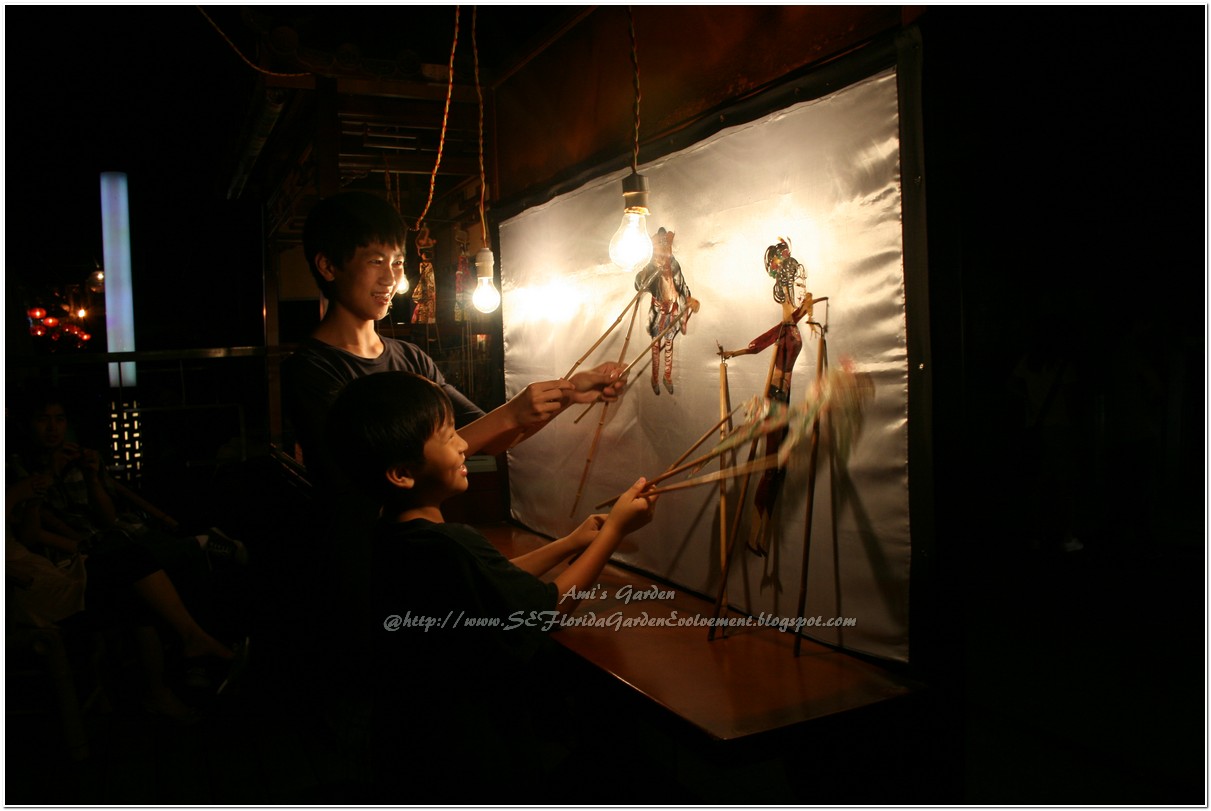
Even it was dark, my boys found something very entertaining.  It was another Chinese traditional art on the street:  Shadow play (Chinese: 皮影戏, Pi Ying Xi) or shadow puppetry.  This is similar to the puppet show.  The difference is that it uses the figures in front of an illuminated backdrop to create the illusion of moving images. 

My boys were moving the puppets using the sticks that were string attached to the figure.


Here is how the figures looked like from the front of the screen.

I am so glad that my boys got some opportunities to feel close to the Chinese culture that day, which we have been trying hard to instill into their life.  Being born and brought up in America, it is not very easy for them to really understand or have the real feeling for the essence of the Chinese culture.  It is a place that definitely we were so happy to take them to.

Saturday, July 31, 2010

China Trip Part 2: Chengdu Panda Research Base

I have not been able to write my China Trip posts as quickly as I have hoped for even I have back from China for 10 days now.  Summer heats in Florida might have put me in a dormant stage :)  Meanwhile, there are so many things need to be done in the garden, and my daytime job is also resuming the speedy pace now...

In my last post, I wrote about my visit to Lake Taihu and The Turtle Head Islet Park located in Wuxi, Jiangsu province.  Although we also went to several other attractions in Wuxi, I decided that I will start writing about another city I visited, ChengDu in Sichuan province.  I always could write more about Wuxi in the future if I could find more time.

ChengDu is the Capital City of Sichuan province, located in Southwest of China.  I have included a map of China to show the locations of Wuxi and Chengdu in my previous post.  Chengdu has a humid subtropical climate, and is largely mild and humid.  For the interest of my gardener readers, its hardness zone is 9, and Wuxi is in Hardness zone 8.

During our stay in China, we visited Chengdu Panda Base, a non-profit research and breeding facility for giant pandas and other rare animals such as Red pandas, and golden monkeys. Chengdu Panda Base was founded in 1987. It started with 6 giant pandas that were rescued from the wild. By 2008, it has had 124 panda births, and the captive panda population has grown to 83 (Source: http://www.panda.org.cn/).

While this base is majorly a research institute, it is also open to the public.  It covers about 600 acres, and the environment is exquisitely designed to create a natural habitat for Giant Pandas and other endangered animals.  It is covered with big trees such as ginkgos, chinars, yulans, willows and embedded with high dense bamboo and grasses.  The human-made structures have been designed to blend well with the natural scenery.

The statue of Mother Panda holding a cub is situated in the entrance of the Base.  Beautiful Cleome flowers in abundance are surrounding the statue. 


I have to admit that I could not stop taking pictures of this beautiful flower when other members in my family had moved on eagerly seeing the pandas!  Love the shape of this flower, and its soft pink, lavender/violet, white colors!


Cleome hassleriana
Common names: Spider Flower, Spider Legs, Grandfather's Whiskers
Allow me to show you some more of the garden pictures before I show you the pandas!  After all, this is a gardening blog, right? 


Now we were off the main road...  Do you think we would spot the pandas soon?

What is that?  Oh, a red panda is in distant!

 Another one on the tree! But, where are those cute Giant Pandas?

Follow me on this path...

Wait, what is this bush that has red flowers on it?


The Close-up of the flower...  I think I have seen this flower in some blog friend's post, but don't remember what is the name.

This unknown vine distracted me once more with its pretty flowers dangling from the tree along the path... 

"Pandas! Mom!"  My boys were calling me.  They did not understand why their mom always walks so slow, and took pictures of anything, or "nothing"! 

Anyway, come back to the Pandas!  Aren't they super cute?!!!

This one was practicing his (or her) balancing skill on the tree...


These two were having relaxing time on their own, not minding all of us taking pictures of them like crazy!


Now we were off to visit the breeding center of the base.  We were so lucky to see a new born baby panda that was only 1 day old!  The baby was still in its incubator.  We were only allowed to watch him through the glass window, and no pictures were allowed to take since the flash light could damage baby's eyes.

Just give you an idea what a newborn giant panda looks like, I borrowed a picture from the Internet.
New born baby pandas (Credit: http://news.nationalgeographic.com/)
A newborn giant panda typically weighs 100 to 200 grams (3 1⁄2 to 7 oz) and measures 15 to 17 centimeters (6 to 7 in) long at birth, and it lacks the familiar black-and-white markings for its first month or so of life.

With only 1,600 giant pandas left in the wild, and nearly 300 pandas live in zoos and breeding centers around the world, mostly in China, you can imagine how precious a birth of the panda is!  Especially for the scientists working in this breeding center!

We were on the way to the exit of the research base now. Of course, I have to show you more pictures of the beautiful scenery on the road. 

Sometimes, a scene with only green color also could look so gorgeous! 
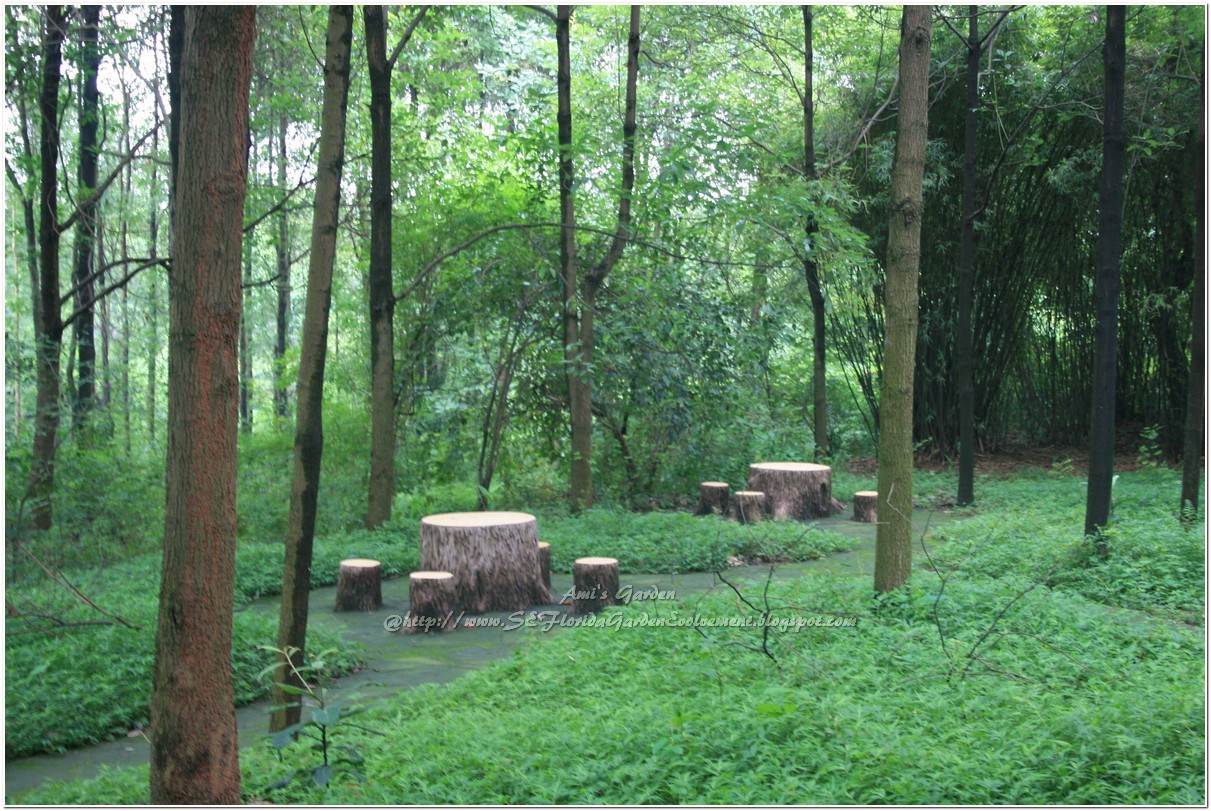
A rest area in the "forest".   Tables and chairs are built with artificial material mimicking tree stubs.


Another surprise for us to see, a Swan lake!

Swans and the gold fish live in harmony...


This concluded our visit to this Panda Research Base.  Next time, I will show you a restored historical resident area in Chengdu city.

** On May 12, 2008, a magnitude 8.0 earthquake struck causing damage to the area, killing lots of people. Though only 75 kilometers (48 miles) from the epicenter, Chengdu itself was built to earthquake specification, and most buildings there remained intact. **
Related Posts Plugin for WordPress, Blogger...